
Sacramento County Crime Sources
Start with official channels. The Sheriff's press releases and social accounts carry selected agency news, but they fall short of a booking feed. Two other tools help. One is a monthly crime-report log; the other is a daily crime map built from finished reports. Both describe incidents, not arrests, and neither works as a mugshot roster. To see who is actually held at the Main Jail or Rio Cosumnes Correctional Center, the county inmate system is the place to look.
City departments add their own layers. Sacramento Police runs a Daily Activity Log of notable calls. Elk Grove Police posts prior-day arrests in a Watch Summary sorted by shift, but those summaries vanish quickly. Citrus Heights keeps separate activity and arrest logs for 30 days. One caution applies to all of them: a log entry does not mean a county booking followed, since an event can end in a citation, a release, or another custody route.
For the full booking picture, the Sacramento County roster and recent-booking treatment sorts out the difference between someone just booked and someone held, released, transferred, or committed to state custody.
Sacramento County News Outlets
No local publisher offers a complete Sacramento County mugshot gallery. Reach, update pace, and image habits vary widely from one outlet to the next. Editors pick photos and video story by story. Their sources include police releases, court filings, press conferences, or scene coverage. The table below starts with agency channels, then moves to editorial outlets.
| Outlet | Coverage | Photo practice | Where |
|---|---|---|---|
| Sacramento County Sheriff | Selected agency releases, social posts, monthly incident data | Selected images, not a booking archive | Crime report log |
| Sacramento Bee | Rolling county, city, crime, and court reporting | No routine police mugshots since 2020; narrow exceptions | Local crime section |
| CBS Sacramento | Daily regional crime stories | Story-specific photos and video with identified sources | Crime section |
| KCRA | Continuous regional breaking and local news | Editorial images, not a blotter | Local news |
| FOX40 | Daily local public-safety coverage | Sometimes uses agency-provided suspect images | Local news |
| ABC10 | Sacramento-region breaking and crime reports | Story photos with named agency sourcing | Regional news |
| Elk Grove Citizen | Recurring Elk Grove police and fire stories | Occasional images sourced to EGPD releases | Police & Fire |
| Elk Grove Laguna News | Watch Summary and weekly safety recaps | Secondary editorial presentation | Recent posts |
| Citrus Heights Sentinel | City police-log reporting | Selective story images, not the official log | Local coverage |
That division is why three reports on one event can look like three different stories. The police item tends to be brief and early. Television adds video or an interview. The newspaper may dig into court filings weeks later. Each version can be accurate for its own stage without being the last word on the case.
Sacramento County Mugshot Policy Shift
The Sacramento Bee changed the region’s media landscape in July 2020 when it stopped routine publication of police mugshots, surveillance images, and composites. Its published mugshot policy retained narrow public-interest exceptions rather than creating a total ban. As the region’s dominant newspaper, the Bee now functions more as a selective source for allegations, public-interest context, and later court reporting than as a lasting photo index.
A missing image therefore reveals little by itself. Editors may never have used the photo, may have applied the policy, or may have corrected a story. The person may also have been cleared, charged differently, or still be awaiting a court result. Read the written attribution and publication date before comparing the account with an official booking or case record.
Sacramento County Story-to-Record Path
A story is where the search begins, not where it ends. It may name the arresting agency, an alleged charge, a rough location, and a date. Those details point toward the custody system. From there, the filed court case follows. Each step along that path answers a different question.
- Record the exact name spelling, event date, named agency, and source cited by the publisher.
- Check the Sheriff’s Inmate Information status banner, then use the name or XREF search for current Main Jail or RCCC custody.
- If the arrest was very recent, use the official 2-, 4-, 6-, 12-, or 24-hour booking window. These are rolling slices, not weekly archives.
- Match the booking number, facility, arrest type, charges, bail, and dates. Do not rely on a name alone.
- Search the Sacramento Superior Court criminal case system for what prosecutors filed and the court’s disposition.
Sacramento's court database reaches back to 1989 and answers to a name or a case number. It holds criminal filings, not bookings. Fingerprints can't confirm identity there, so match carefully. Once someone leaves custody and the roster trims its detail, the docket becomes your best window into what happened next.
Here is the shape of a case. An arrest leads to booking, maybe a photo, and a spot on the custody roster. From there the prosecutor files, arraignment follows, and the court settles the outcome. Knowing that order keeps an early police report from being confused with the end of the story.
Sacramento County Arrest-Log Patterns
The county's three biggest cities handle their records quite differently. Sacramento's Daily Activity Log picks out significant events and can leave out details for privacy reasons or an open investigation. Treat it as a curated feed, not a complete arrest log, since its early field reports may change. Elk Grove's Watch Summary comes closer to a true arrest feed. It groups prior-day arrests by Night, Day, and Evening Watch, and items from Friday through Monday usually post on Tuesday. Its web copies vanish quickly.
Citrus Heights takes another approach. The city posts separate activity and arrest logs that stay online for 30 days, having restored daily police logs in March 2023, a move tracked by the Citrus Heights Sentinel. Keep in mind that these windows apply only to what the public can see on the web. A record dropping off a city page does not mean the agency erased it from its files.
City police work and county custody are two separate things. A Sacramento, Elk Grove, or Citrus Heights arrest can end in a Sheriff booking, but the arresting agency and the holding agency remain distinct facts. Readers in each city can follow their own local route through the Sacramento, Elk Grove, and Citrus Heights Busted Mugshots pages in the navigation, without confusing a police log with a jail list.
Unofficial Sacramento County Mugshot Sites
Commercial mugshot aggregators trail behind official sources and local news. They copy; they don't break stories. Their pages can carry stale names, missing outcomes, and mislabeled photos, all refreshed on whatever schedule suits the site.
| Service | Sacramento finding | Reliability limit |
|---|---|---|
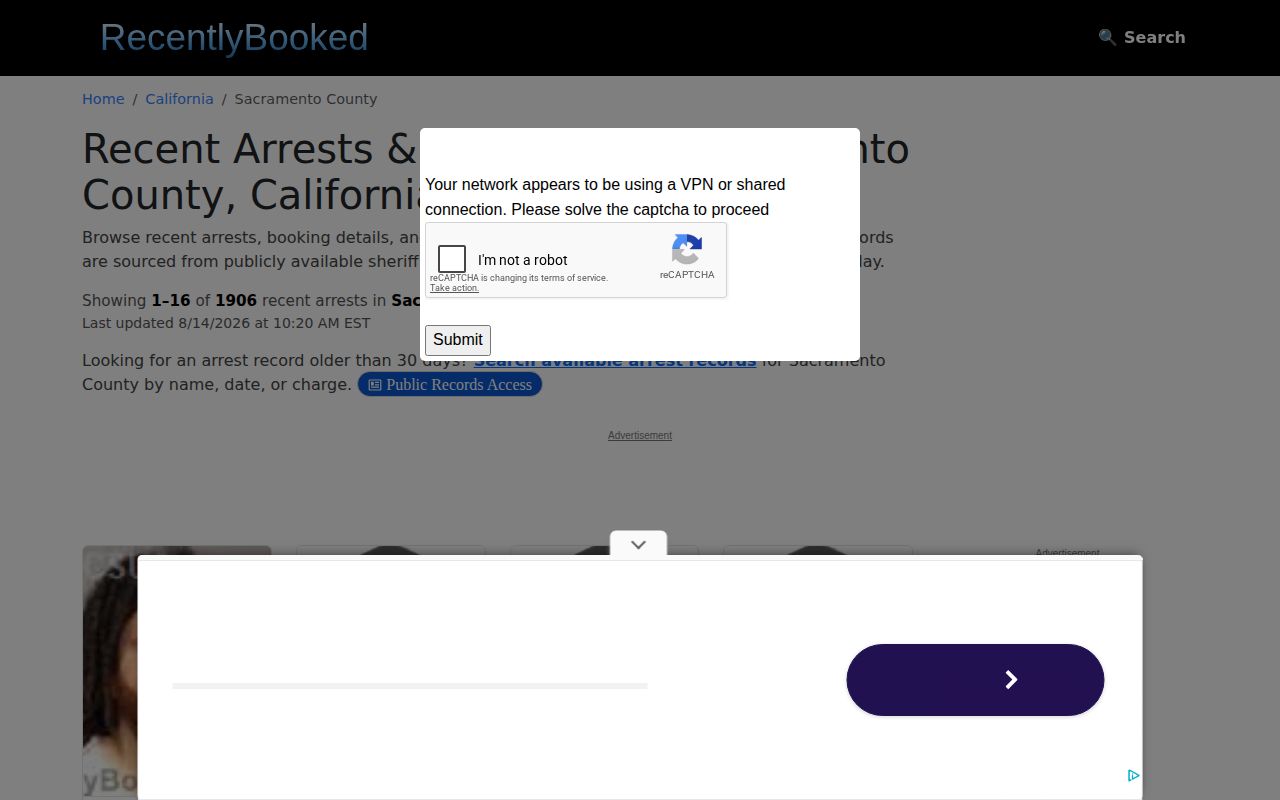
| RecentlyBooked | A local county section exists, presenting about the prior 30 days and claiming multiple daily refreshes | Unofficial; count changes, and its text about Sacramento photo supply was internally inconsistent |
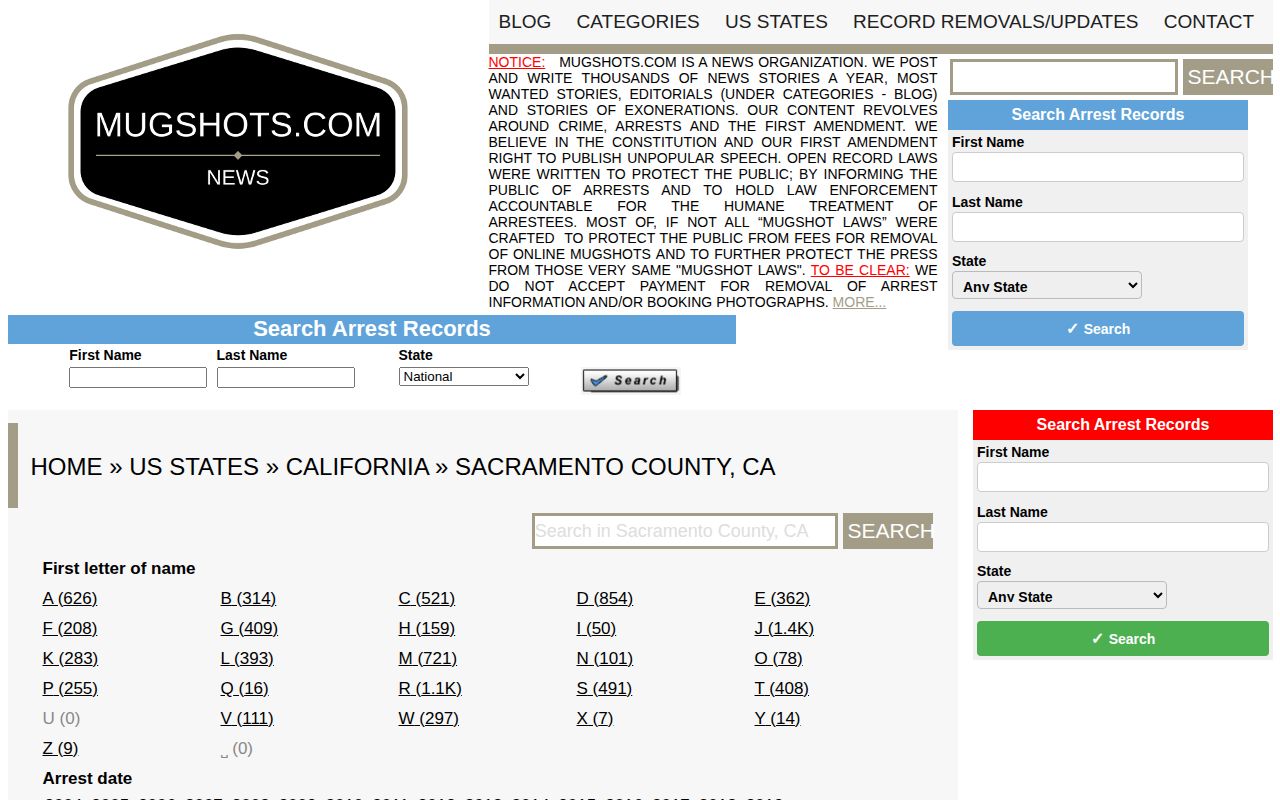
| Mugshots.com | Local archival section exists | Visible date range ended in 2019, so it is not a recent-booking feed |
| Arrests.org | No Sacramento County section found as of August 13, 2026 | Its California inventory listed other counties; no local page should be inferred |
| Busted Newspaper | No California or Sacramento section found | A generic search is not a county feed |
| Mugshots.zone | No Sacramento landing page was verified | The expected page failed, so no local URL should be invented |
The live RecentlyBooked Sacramento County interface shown below offers a secondary example of that landscape. It is not an official source and not a complete record.
The Mugshots.com Sacramento page below appeared archival rather than current when researched.
Verify Sacramento County Crime Reports
Begin with the named agency. Compare dates and pin down what the article actually describes: an incident, an arrest, a booking, a warrant, or a court filing. Then match that stage to the right system. The Sheriff roster shows current county custody. City logs offer brief incident context that disappears fast. Sacramento Superior Court holds prosecution and case outcomes. CDCR CIRIS matters only after a qualifying state-prison commitment, not for county arrestees generally.
Timestamps deserve as much attention as names. Sheriff data aim to stay current but may carry a delay notice. Detailed inmate information exists only during custody; once someone is released, the public view shrinks to a release date and time. A later report can still reference the original booking, so a thin roster result does not contradict the story.
Precision in wording matters most. Write "police alleged," "the booking record listed," or "the court docket shows." An image caption is just that. It was never meant to settle anything.
Sacramento County Social Mugshots
One state law reshaped how agencies handle booking photos on social media. California Penal Code § 13665 generally requires a covered police or sheriff social-media booking image to come down within 14 days. An exception applies if keeping it up serves a listed purpose. Think of locating a wanted person, flagging an imminent threat, supporting a judicial process, or meeting an urgent law-enforcement need. The California Attorney General's legal alert makes clear that an agency cannot dodge the rule by picking a different arrest photo.
The rule covers agency social posts, including older ones still online. It does not turn a newspaper into a police social account. Nor does it govern the Sheriff's electronic custody database the same way. That is why an Instagram or Facebook photo can vanish while the arrest fact, the current roster entry, or the Superior Court case stays available.
Agency accounts stay selective in any case. Sheriff's posts on Facebook, X, YouTube, and Instagram deliver news, not a systematic booking publication. Sacramento Police eNotify sends a daily digest. It may include press releases and prior-day neighborhood or helicopter activity, but it is no arrest feed. Treat social content as a way to spot the reporting agency and the event date, then move to the source record.
Note: Whether a photo reaches the news depends on the release, the newsroom's decision, and California law, not on any universal county photo feed.